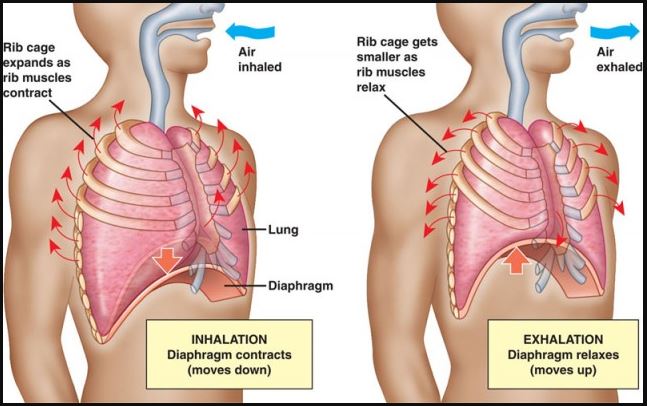
When you breathe in, your body takes in oxygen. When you breathe out, your body expels carbon dioxide. It is important for our bodies to continually exchange these two gases, and it is the respiratory system that is doing that job for you.
The parts of the respiratory system include:
The
Tracheaor windpipe: a tube which extends from the larynx to the bronchial tubes and moves air to and from the lungs;
The
Bronchial Tubes(including the alveoli): two tubes which move air from the trachea to the lungs;
The
Lungs: they have numerous alveoli where the exchange of gases occurs;
The
Capillaries: the smallest of blood vessels. which distribute oxygenated blood from arteries to the tissues of the body and feed deoxygenated blood from the tissues back into the veins;
The
Diaphragm: a dome-shaped, muscular partition which separates the lungs from the abdomen and plays a major role in the breathing process
Observe in the picture how ribs are moving outward and diaphragm is moving downward when we inhale.
When we exhale/ Breathe out the Ribs move inward and diaphram become dome shaped/ relaxed.