Solved Examples
Example : 1
The experimental data for the reaction 2A + B2 → 2AB is as follows:
|
Expt. No. |
[A] |
[B2] |
Rate |
|
1 |
0.50 |
0.50 |
1.6×10⁻⁴ |
|
2 |
0.50 |
1.00 |
3.2×10⁻⁴ |
|
3 |
1.00 |
1.00 |
3.2×10⁻⁴ |
 Write the most probable equation for the rate of reaction giving reason for your answer.
Solution :
From an examination of above data, it is clear that when the concentration of B2 is doubled, the rate is doubled. Hence the order of reaction with respect to B2 is one.
Further when concentration of A is doubled, the rate remain unaltered. So, order of reaction with respect to A is zero.
The probable rate law for the reaction will be -dx/dt = k[B2][A]0 = k[B2]
Alternatively Rate = k[B2]α
1.6 × 10-4 = k[0.5]α
3.2 × 10-4 = k[1]α
On dividing we get α = 1
.·. Rate = k[A]0 [B2] = k[B2]
__________________________________________________________________________
Example : 2
For the reaction A + 2B → 2C the following data were obtained.
|
Expt. No. |
Initial concentration |
Initial reaction rates |
|
|
|
[A] |
[B] |
|
|
1 |
1.0 |
1.0 |
0.15 |
|
2 |
2.0 |
1.0 |
0.30 |
|
3 |
3.0 |
1.0 |
0.45 |
|
4 |
1.0 |
2.0 |
0.15 |
|
5 |
1.0 |
3.0 |
0.15 |
Write down the rate law for the reaction.
Solution :
Let the rate law be
-dx/dt = k[A]x [B]y
By keeping the concentration of B constant in experiments (1), (2) and (3) and increasing concentration uniformly, the rate also increases uniformly, thus,
Rate ∞ [A], i.e., x = 1
By keeping the concentration of A constant in experiments (1), (4) and (5) and increasing the concentration of B, the rate remains the same.
Hence, y = 0
The rate law is -dx/dt = k[A]
Alternatively method:
From Expt. (1), k[1.0]x [1.0]y = 0.15 ....(i)
From Expt. (2), k[2.0]x [1.0]y = 0.30 ... (ii)
Dividing Eq. (ii) by Eq. (i), [2.0]x /[1.0]x = 0.30/0.15 = 2
So , x = 1
From Expt. (1), k[1.0]x [1.0]y = 0.15 ....(i)
From Expt. (4), k[1.0]x[2.0]y = 0.15 .... (iii)
Dividing Eq. (iii) by Eq. (i),
[2.0]y /[1.0]y = 1
So , y = 0
Hence, the rate law is -dx/dt = k[A].
___________________________________________________________________________________
Example : 3
For the reaction: 2NO + Cl2 → 2NOCl at 300 K following data are obtained.
|
Expt. No. |
Initial concentration |
Initial rates |
|
|
|
[NO] |
[Cl2] |
|
|
1 |
0.010 |
0.010 |
1.2×10⁻⁴ |
|
2 |
0.010 |
0.020 |
2.4×10⁻⁴ |
|
3 |
0.020 |
0.020 |
9.6×10⁻⁴ |
Write rate of law for the reaction. What is the order of the reaction? Also calculate the specific rate constant. .
Solution
Let the rate law for the reaction be
Rate = k[NO]x [Cl2]y
From Expt. (1),
1.2×10-4 = k[0.010]x [0.010]y ... (i)
From Expt. (2),
2.4×10-4 = k[0.010]x[0.020]y ... (ii)
Dividing Eq. (ii) by Eq. (i),
(9.6×10⁻⁴)/(2.4×10-4) = ([0.020]x )/[0.010]x
or 2 = (2)y
y = 1
From Expt. (2), 2.4×10-4 = k[0.010]x [0.020]y .... (ii)
From Expt. (3), 9.6×10-4 = k[0.020]x [0.020]y .... (ii)
Dividing Eq. (ii) by Eq. (ii),
(9.6 × 10⁻⁴)/(2.4 × 10-4) = ([0.020]x )/[0.010]x
or 4 = 2x
x = 2
Order of reaction = x + y = 2 + 1 = 3
Rate law for the reaction is
Rate = k[NO]2 [Cl2]
Considering Eq. (i) again,
1.2 × 10-4 = k[0.010]2 [0.010]
k = (1.2×10⁻⁴)/[0.010]3 = 1.2×10² mol-2 litre2 sec-1
________________________________________________________________________________________________________
Example :4
For the hypothetical reaction 2A + B → products the following data are obtained.
|
Expt. No. |
Initial concentration |
Initial reaction rates |
|
|
|
[A] |
[B] |
|
|
1 |
0.10 |
0.20 |
3×10² |
|
2 |
0.30 |
0.40 |
3.6×10³ |
|
3 |
0.30 |
0.80 |
1.44×10⁴ |
|
4 |
0.10 |
0.40 |
|
|
5 |
0.20 |
0.60 |
|
| 6 | 0.30 | 1.20 | |
Find out how the rate of the ration depends upon the concentration of A and B and fill in the
blanks.
Solution :
From Expt. (2) and (3), it is clear that when concentration of A is kept constant and that of B is doubled, the rate increases four times. This shows that the reaction is of second order with respect to B.
Similarly, from Expt. (1) and (2), it is observed that when concentration of A is increased three times and that of B two times, the rate becomes twelve times. Hence, the reaction is
first order with respect to A.
Thus the rate law for the reaction is
Rate = k[A][B]2
(iv)
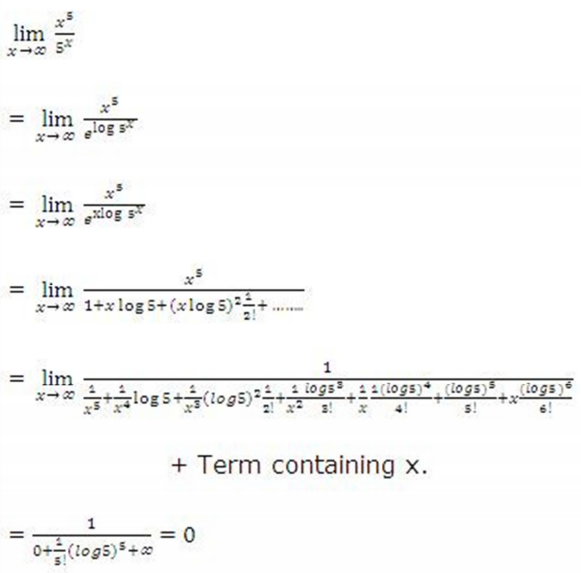
(v)
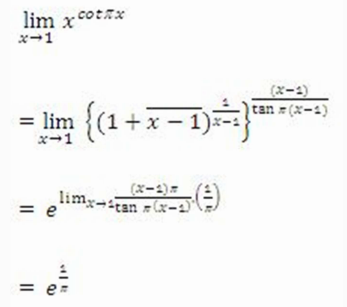
From Expt. (1), 1.75×10-4 = k[0.0017]x [0.0017]y [1.0]z
From Expt. (4), 3.50×10-4 = k[0.0017]x [0.0017]y [0.5]z
(1.75 × 10⁻⁴)/(3.50 × 10-4) = [1.0]z /[0.5]z
or 1/2 = 2z
or 2-1 = 2z
z = -1, i.e., order w.r.to OH- is -1.
Rate law = k[OCI- ][I- ]/[OH-]
From Expt.(1)k = (1.75×10⁻⁴[OH- ])/[OCI-][I-] = (1.75 × 10-4×1.0)/(0.0017×0.0017) = 60.55 s-1
____________________________________________________________________________
Example : 5
The rate law for the reaction, 2Cl2O → 2Cl2 + O2 at 200oC is found to be : rate = k[Cl2O]2
(a) How would the rate change if [Cl2O] is reduced to one-third of its original value?
(b) How should the [Cl2O] be changed in order to double the rate?
(c) How would the rate change if [Cl2O] is raised to threefold of its original value?
Solution :
(a) Rate equation for the reaction,
r = k[Cl2O]2
Let the new rate be r'; so
r' = k[(Cl2 O)/3]2 = 1/9 r
(b) In order to have the rate = 2r, let the concentration of Cl2O be x.
So 2r = kx2 .... (i)
We know that r = k[Cl2O]2 .... (ii)
Dividing Eq. (i) by (ii),
2r/r = (kx2 )/(k[Cl2O]2 )
or 2 = x2/[Cl2O]2
or x2 = 2[Cl2O]2
or x = √√2 [Cl2 O]
(d) New rate = k[3Cl2O]2 = 9k[Cl2O]2 = 9r
_____________________________________________________________________________________________________
Example : 6
For a reaction in which A and B from C, the following data were obtained from three experiments:
|
Expt. No. |
Initial concentration |
Initial reaction rates |
|
|
|
[A] |
[B] |
|
|
1 |
0.03 |
0.03 |
0.3×10⁻⁴ |
|
2 |
0.06 |
0.06 |
1.2×10⁻⁴ |
|
3 |
0.06 |
0.09 |
2.7×10⁻⁴ |
What is the rate equation of the reaction and what is the value of rate constant?
Solution:
Let the rate equation be k[A]x [B]y
From Expt. (1), 0.3×10-4 = k[0.03]x[0.03]y ... (i)
From Expt. (2), 1.2×10-4 = k[0.06]x [0.06]y ... (ii)
(1.2 × 10⁻⁴)/(0.3×10-4) = ([0.06]x [0.06]y)/([0.03]x [0.03]y) = 2x × 2y = 4 ... (iii)
Similarly from Expt. (1) and (3),
2x ×3y = 9 ....(iv)
Solving Eq. (iii) and (iv),
x = 0, y = 2
Rate equation, Rate = k[B]2
Considering Eq. (i) again,
k = (0.3×10⁻⁴)/[0.03]2 = 3.33 × 10⁻² mol L-1 s-1
________________________________________________________________________________
Example : 7
For a first order reaction when log k was plotted against , a straight 1/T line with a slope of -6000 was obtained. Calculate the activation energy of the reaction
Solution
Slope = -Ea/2.303R = –6000
Ea = 6000  2.303 8.314
= 1.148 105J
= 27483.935Cal = 27.48 Kcal
Example : 8
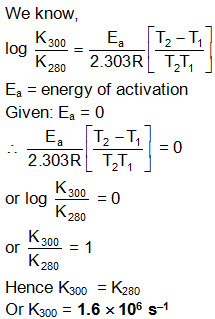
For a reaction, the energy of activation is zero. What is the value of rate constant at 300 K if k = 1.6 106 s–1 at 280 K? (R = 8.31 J K–1 mol–1)
Solution:
We know,
___________________________________________________________________________________________
Example : 9
The time required for 10% completion of first order reaction at 298 K is equal to that required for its 25% completion at 308K. If the preexponential factor for the reaction is 3.56 ´ 109 s–1, calculate the energy of activation
Solution:
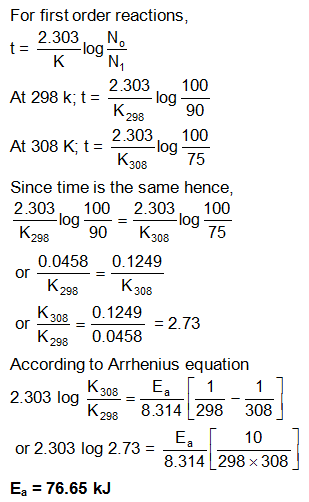
_________________________________________________________________________________
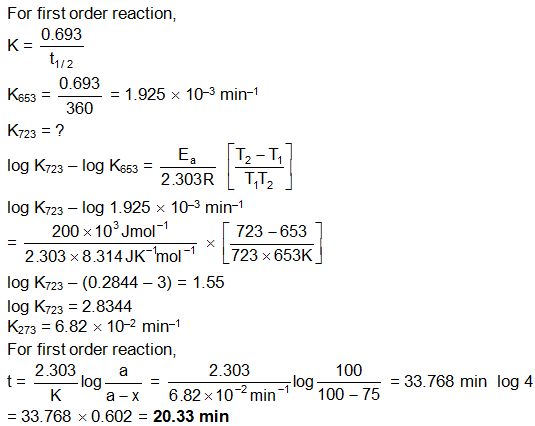
Question : 10
At 380°C, the half-life period for the first order decomposition of H2O2 is 360 min. the energy of activation of the reaction is 200 kJ mol–1, Calculate the time required for 75% decomposition at 450°C.
Solution:
 Download IIT JEE Solved Examples for Molecularity and Order of Reaction
Related Resources:-
-
Look here for Syllabus of IIT JEE
-
click here for Books of Chemistry for IIT JEE
-
You can also refer to Collision Theory of Reaction Rate
To read more, Buy study materials of Chemical Kinetics comprising study notes, revision notes, video lectures, previous year solved questions etc. Also browse for more study materials on Chemistry here.
View courses by askIITians


Design classes One-on-One in your own way with Top IITians/Medical Professionals
Click Here Know More

Complete Self Study Package designed by Industry Leading Experts
Click Here Know More

Live 1-1 coding classes to unleash the Creator in your Child
Click Here Know More