

Grade 12IIT JEE Entrance Exam
How to find the moment of inertia of a solid cone about its central axis..??
How to find the moment of inertia of a solid cone about its central axis..??

How to find the moment of inertia of a solid cone about its central axis..??

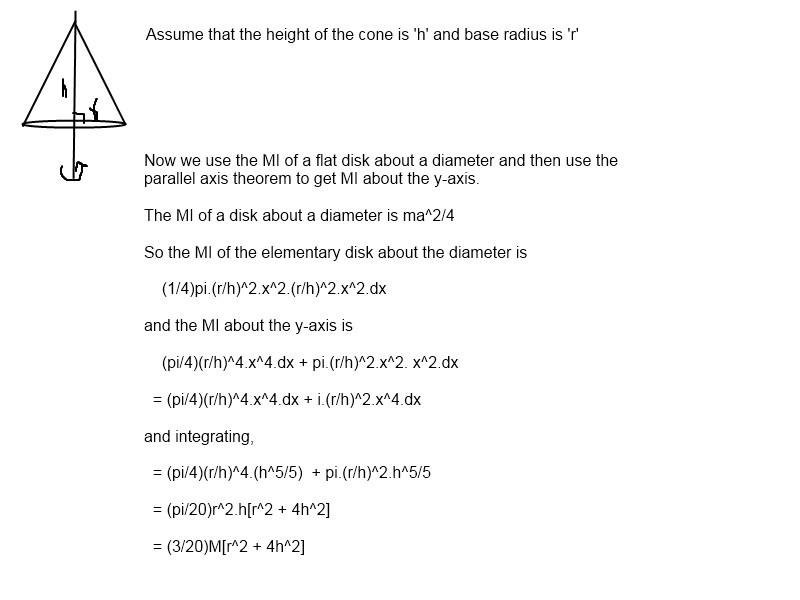
Please approve !
Dear student,
The moment of inertia of a cone about its central axis, start with the standard Intertia equation
I = integral r^2 dm
dm = rho dV (rho is density) (dV is basically volume)
dV = r dr dtheta dx
not going to prove that here but you will see in the integral that this does indeed form the volume. integral will be refered to as int from here on.
This now forms the triple integral
I = rho int(0 to H) int(0 to 2pi) int(0 to r) r^3 dr dtheta dx
solving the integral leaves
I = rho int(0 to H) int(0-2pi) 1/4 r^4 dtheta dx
solving the second integral leaves
I = rho int(0 to H) 1/2 pi r^4 dx
ok so now you have to sub in the equation for r (the radius) of the cone
r = (R/H)x
this is the radius at the base divided by the height of the cone multiplied by the distance along the x axis. this equation gives you r at any point this gives you
I = rho int(0 to H) 1/2 pi [(R/H)x]^4 dx
time to do some housekeeping and take all the constants outside the integral
I = (rho pi R^4) / (2 H^4) int(0 to H) x^4 dx
this can now be solved and simplified to
I = (rho pi R^4 H) / 10
At this stage your solution is complete, however you can tidy up the equation by taking out the mass term.
m = (rho pi H R^2) / 3
split the Inertia term up to serperate out the mass term
I = [(rho pi H R^2) / 3]*[ (3R^2)/10 ]
this is now the complete solution in terms of mass
I = (3mR^2)/10

Let S={x:x belongs to R(√3+√2)^(x^2-4) - (√3-√2)^(x^2-4)=10}. Then n(S) is equal to-
Last Activity: 10 Months ago
Last Activity: 3 Years ago
Last Activity: 4 Years ago
Last Activity: 4 Years ago